Thursday, December 29, 2011

Why do I want to study art?


When I was younger, I never considered myself an artist. I didn't draw or paint or sculpt.  That's what makes an artist right?  I felt like being called an artist puts a person in some sort of elite group that I didn't belong to.  After a long time though I realized that a lot of what I love to do is art, even though almost none of it had anything to do with drawing, painting, or sculpting.  Here is a brief history of my artistic endeavors.

When I was in high school I had a big stack of magazines that I had inherited from my older sister when she moved out of the house.  I slowly turned that stack into collage after collage until my entire room, every spot on the walls and ceiling, became one huge collage.  Me, scissors, paper and a glue stick.  Also during high school I had a few pen pals and I loved to decorate my envelopes before sending the letters to my friends.  In fact, even though I wasn't drawing landscapes or portraits, one could consider my envelope masterpieces to be "drawing".  I even used a ruler some of the time!  Some people seemed to think that I put more energy into the envelope than on the actual letter, but, hey, what's wrong with that?

I love homemade things.  I found instructions for paper making in a zine one day and my curiosity was piqued.  I wondered if I could actually do that.  As an adult, I delved into cheap hobbies like that.  I used recycled materials that I just happened to have in abundance in my small rented house.  My best friend and I made many, many candles from melted candle scraps. One day I was gifted the Reader's Digest Book of Crafts and Hobbies.  It was my go-to source for entertainment since I was pretty much poor.  I often just read it over and over, learning about mosaics, batik, basket weaving, pottery, sewing, and book binding.  The book binding was most interesting to me, and I began making piles of little journals.  I also found a recipe for  homemade soap and went crazy with that.  Everybody got soap and journals for Christmas that year.

Next came my obsession with making bulletin boards out of used wine corks.  Did you know that you can go into nearly any restaurant in town and ask them to save their wine corks for you and they'll do it?  Total score!  Free art supplies!  After that I took note of brick patterns on buildings and pavements everywhere so that I could copy some and use some for inspiration on my cork boards.
This is the only cork board I still have, since I usually give away everything I make.  I just happen to have given this one to my partner :).

I started to collect any books on arts and crafts that I found interesting that I could find at Goodwill.  Unbeknownst to myself I was beginning to amass quite a library of resources.  For some reason there was quite an abundance of books on macramé at Goodwill at that time, and I noticed that a lot of people were wearing hemp necklaces, so I dived into the pool of macramé, and made necklace after necklace, and when I inherited a box of embroidery floss from my ex-boyfriend's grandma, I began knotting up a pile of friendship bracelets.  I had visions of going to festivals and selling them and never having a "real job" again.  I was so silly.
Ten years later, I still have quite a few of these left.  You can get a sense of my color  pattern experimentation of that time.

Hemp chokers.  All the same, but all different.

More hemp necklaces.


Next on my list was painting found wooden objects.  I painted any wooden bowls, candle holders, salt & pepper shakers, or any other functional objects I could find at Goodwill.  You may have noticed that I tend to do everything in multiples.  Here are a few samples of my only painting experience thus far:
Inside.

Outside.


My next endeavor was to make envelopes out of pages from magazines, books, atlases, etc. I guess I kind of have a thing for the US Postal Service.  I was simultaneously crafting greeting cards out of similar materials in addition to scrapbooking supplies, canceled stamps, etc., and while I was at it I delved into Altered Booking as well.  A friend of mine showed me how to make a different kind of journal using the stab-binding method, and so my love for bookbinding was renewed and I stitched together book after book once again.  


Envelopes make a comeback!  You can see on the eagle envelope on the right where I put some 2-sided tape  for sealing it once it's stuffed.  
One day, about 8 years ago now (really?!), my friend's mom came to visit and was carrying her crochet project with her everywhere we went.  I mentioned that I had always wanted to know how to knit and crochet and she didn't hesitate one minute to give me a hook and a skein of purple wool yarn and teach me how to make a chain stitch, single crochet and double crochet.  I have not put my hook down since that day!  Comme d'habitude, I have given away most of the things I have crocheted over the years which include, hats of all sizes, dress-up crowns, purses and other bags, scarves, dishcloths, balls, beanbags, dolls, baby blankets, and a whole set of fruits and vegetables that I gave to my children last Christmas.  I have also intermittently done some knitting and felting.  I just love yarn and fiber! 
Fruits and veggies.  Crocheted with organic cotton yarn and stuffed with bamboo fiberfill.

Shoulder bag crocheted with self-striping wool yarn.


Stellated Dodecahedron.
One day at a Stitch 'n Bitch, I met a guy, I can't remember his name because all the ladies there that night kept calling him "Crochet Guy," and he told us all that he was a student at the UofO and his major was called "Textiles and Weaving".  Hmm.  I decided that night that if I ever chose to go back to school and get a degree that I would choose that as my major.  After all, fibers, if not art in general, have been the most consistent source of my happiness and well-being.

Shortly afterward, I got an application to the University of Oregon, and I have been working my way toward my goal since then.  The only reason I haven't declared my major before now, is that I need to apply separately to the Art Department and I wanted to get some art related experience on my degree audit before taking the big leap.  Now that I have studied Art 101, Art 199 (Bookbinding!) and some Art History, I am compiling my portfolio and getting the application together as well as being signed up for Art 115 for the upcoming Winter Term.  I am looking forward to learning how to weave and many of the other art forms accessible to me at the University!
These are the journals I made last month in Art 199
And for a few final images, my most recent projects are some things I made for my partner for Christmas.  A hat with a bill and a decorative strap with buttons, and a felted dragon:


I know this is rather long, but believe me when I say it is the abridged version!  There are a lot of other things I could have mentioned, but chose to leave out for the sake of brevity.  

Friday, March 11, 2011

The artists from this week's readings were Gabriel Orozco and Justin Novak.  I found them to be basically opposite sides of a coin -- polar opposites -- perhaps 2 kids sitting on opposite ends of the see-saw.  With Gabriel Orozco, I felt comforted by his playful art.  He took an organic approach and let his ceramic pieces define themselves.  He didn't intend for them to look like anything in particular, but they turned out looking like a loaf of bread or a fish, just by coincidence, or merely by the skewed perspective of the viewing eye.  Orozco's ceramic pieces are abstract objects of beauty.
"It’s not that it represents anything, but it represents...its own reason to exist..."
Justin Novak, on the other hand (or end of the see-saw), his pieces are definitely representational, it is very clear what they are supposed to be, and the viewer does not get a chance to think, "what could this possibly be telling me?"  as with Orozco's pieces.  It is very obvious that his disfigurines are detailed knick-knacks who are cutting their own skin open or sticking their fingers into their open lacerations.  It's a violent image.  Ty challenged us to look beyond our initial feeling of disgust when observing these things, but I just can't do it.  I look at a gross, violent image and I have to immediately look away.  That is not the art for me.  I'm going to stand in the self-righteous corner on this one. 

I am equally repelled by the 21st Century Bunnies.  I do not need to see cute little bunnies with big scary guns.  I have seen more than my share of guns in all the news, tv shows, movies, video games, etc in my life already.  I don't think we need to see any more, even if they are sarcastic guns that are trying to make a point.  I'd rather see peaceful forms of humor and playfulness.  I kind of think the grandma's good china bunnies are cute (but I think the placement of their ears is unusual).
"Granny's good china" could use some 21st century bunny s&p shakers like this, lol.
So, the mention of peaceful humor and playfulness makes me want to talk about Gabriel Orozco some more!  I think we must have seen his oval billiard table some other time this term; it is really familiar to me and I can't think of any other reason it would be.  I like it.  Take a game that's already fun and change the rules just slightly.  Don't even change the rules, just change the shape of the table.  Suddenly there's a whole new game.  That's fun! 
Similarly, you could change the shape of, say, a ping-pong table and make it a 4-person game instead of 2, and turn the net into a pond...  Oh look, Orozco has already done that!  How fun!


We also talked a lot this week about the idea of multiples in art.  Our soft-spoken guest presenter Brian Gillis has been asking himself about multiples for quite some time now.  What is a multiple?  Linda Albright-Tomb defines a multiple as “... a three-dimensional object that is intended to exist not as a unique work of art, but as an editioned original.” According to Gillis, there are 3 types of historical multiples:  Multiples of the Ancients, of Duchamp, and of the Pop-Art era.  To Duchamp, who has enough clout to earn himself his own category in the "What is a multiple?" list, "one was unique, two was a pair, and 3 was to mass produce."  So there need to be at least 3 of something to make it a multiple.  The 3 or more do not have to be completely identical.  They can be slight variations of one another.  They can be great variations of one another also. 

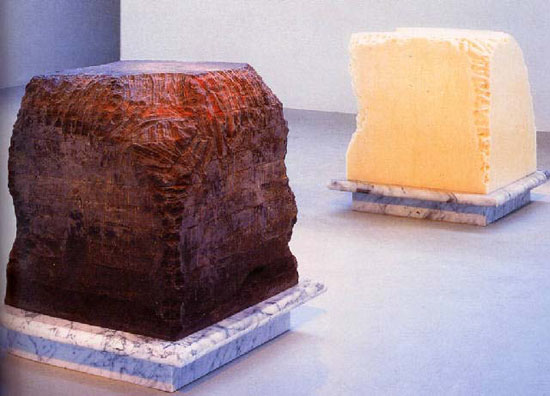
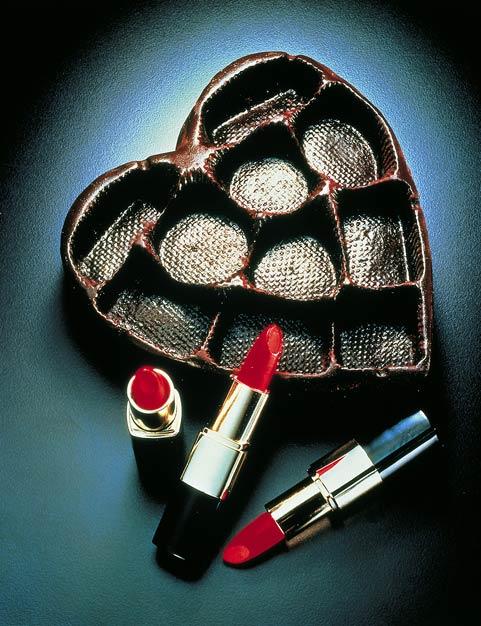
They don't even have to be objects at all; they can be repeated motions, such as the gnawing of a 4'x4'x4' block of chocolate or lard by Janine Antoni in her performance piece entitled simple "Gnaw".  It's true that her performance yielded multiple objects of spit out chocolate pieces into a heart shaped box, and spit out pieces of lard which were blended with red colorant and turned into lipstick, as an end result to take away from the piece, but those things never would have existed or mattered in the same way without the "multiple action" that created them. 

Apparently, multiples are greatly associated with the ceramics medium.  When Justin Novak was questioned about multiples, he seemed to be excited about the idea of making just one of something with the possibility of making multiples of it.  Perhaps making a mold for an object but only using it once.  There is the potential there for an endless number of editions to be made, but you can choose to make only one.  I like that idea too. 

Friday, February 25, 2011

Craft and Methods of Production

Our guest presenter for this week was Anya Kivarkis.  Her presentation was very fast-paced so it was hard to engage in each slide, but I was exposed to some very outlandish, unique and interesting artistic ideas. 

One of the things that stood out to me was Richard Nelipovich's Emergent Tableware.  His method of production is called "Mass individualization".  His idea is to make multiple copies of a piece, but make each one completely different from the others. 
Notice how each fork has, not only its own unique handle, but even the tines are different on each one.  Nelipovich uses a computer program to configure multiple variations of a design, and makes it reality.  I looked at his website http://www.designercraftsman.com/portfolio_digital_craft.html because I was interested in this Mass Individuation, and discovered that he uses the same (or similar) computer program to design many different products including jewelry, chairs, bowls, vases, and more. 
 Looking around at other things in his portfolio, I discovered that he also invented a large number of products that are being sold by big name companies such as Sears.  When I learned that, it made me like his design-ware a little bit less.  That's a curious thing to me.  Does the fact that he sells his art through major department stores actually devalue them in some way?  I'm not sure where that bias came from.  I'm also not sure where I thought all those products came from -- little elves maybe... surely I didn't think that the CEO's of those companies came up with all those designs themselves!  It's just one more thing to think about now.

I think that's part of the point of Kivarkis' presentation.  She showed us a number of artists who take previously mass-produced products, and use them as a base for an artistic creation.  For example, Gijs Bakker takes old cheap costume jewelry, which is made of glass and fashioned after jewelry that is made of real gems, makes a smaller copy of it out of real valuable gems and attaches it to the original "copy".  A valuable copy of a less valuable copy of a valuable piece of jewelry -- it's ironic!
Can you see the smaller version attached to the center of the larger one?
The artists presented by Kivarkis create objects that require the viewer to think.  They're almost making a mockery of the things they are emulating, and questioning the function of each object.  John Feodorov, the artist from our reading for this week, also brings the same challenge to his viewers. 

Feodorov is Native American and was raised as a Jehovah's Witness.  Living in such dichotomy created in him a person who questions everything around him.  "Brought up both in the suburbs of Los Angeles and on a Navajo reservation in New Mexico, Feodorov early experienced the cultural differences between his dual heritages. He also observed the stereotypes present in American culture at large, where Native Americans were idealized as the living embodiment of spirituality by New Age consumerists."  (Oops! --  I'm one of those New-Agers who thinks of Native Americans in that light!)  He reiterates a few times in the reading that he's not trying to be funny, he's just trying to present both perspectives simultaneously.  Last week we learned that interpretation is up to the viewer, and I don't know what this says about me as a viewer, but I was giggling and cracking up over almost every piece of his artwork that I saw.  The irony is so, I don't know, I guess hilarious.  Just take his Animal Spirit Channeling Device for the Contemporary Shaman for example:
He took this mas produced children's toy that we are probably all familiar with in one form or another, and added feathers and the word "spirit" under the name of each animal.  That's how the modern consumer can discover his or her animal spirit guide.  No inconvenient rite of passage necessary, just pull the string.  (If you don't like the first one the feathered arrow lands on, just pull the string again!  It's easy and fun!) 


I appreciate his use of Barbie doll arms in many of his installations.  I am hoping that he acquires all the dolls second-hand, as well as the teddy bears he uses for his "Totem Teddies," rather than supporting the industry which he is mocking by purchasing them all new.  Here is a picture from his production "Art in the Twenty-First Century".
Feodorov says, "the branches are made of doll arms and are holding little plastic miniature toy animals, again sort of reflecting the Disney mentality of nature that I think has evolved just this century."  Good point, and thanks for making people think about what they are seeing, not only in your art, but in the things in their everyday lives.  There's a lot we take for granted, but there is way more than one perspective on everything.

Friday, February 18, 2011

The artist is important, but the viewer is equally as important

This week in Art 101 we read a very intellectual article written by Roland Barthes called "Death of the Author".  The author in question is a metaphor for an artist in this case.  I might use the words interchangeably since they are both representing the same concept.
He's killing the author by reading that book!

In Barthes's article, he was conveying to the reader that every individual has his or her own perspective and will have a unique interpretation upon observation or reading of any given piece of art or literature.  
He brings in the analogy of the "death of the author" as a way of saying that even though every author has a specific idea in mind when writing a story or book, the moment he/she stops writing, his/her own interpretation stops (dies) and it is now under the will of the reader to interpret in his/her own way.  No matter what, an individual will always bring meaning to what he/she sees.  Sometimes, even as the author/artist, if you let go of your idea the piece becomes its own thing.  Ty demonstrated the truth of this idea by showing the class a picture of a man with a dog sitting on his lap and asked us to tell her what we saw.  Every single person saw something different, perhaps similar, but not the same.

 
What do you see?

We also watched "Anything is Possible," a very entertaining film about William Kentridge who is an artist and decided to take his drawing abilities to a new level by creating an opera called "The Nose".  He proclaimed that, "My job is to make drawings, not to make sense."  According to what we've learned in class this week, he is exactly correct.  It is the job of each individual viewer to make the sense.  The concept is that the artist is important, but the viewer is equally as important. Without the viewer, what is the point of making art as an expression?
Kentridge's drawings are fully incorporated into the opera.

For Kiki Smith, "art is just a way to think... It can also have meaning to somebody else who can fill it up with their own meaning."  She also says "I'm very attached to needing proof of something, a proof that there has been a change."  Smith compares art to Catholicism.  She says that "both believe in the physical manifestation of the spiritual world, that it's through the physical world that you have spiritual life.  She learns through observation.  "I won't believe things that people tell me until I can see it myself somehow."  She can relate to Bob Dylan's line, "You don't need a weatherman to know which way the wind blows."  I guess as observers of art, that's true for each of us.  We don't need anyone to tell us what something means, because we all have our own interpretations.

Smith makes sculptures of women of every size -- life size to  sculptures small enough to hold in one's hands.  She is particularly taken by the Bodhisattva of  Compassion, Kuan Yin.  She says, "Kuan Yins tell me to pay attention... I saw one the other day and it said pierce me with your eyes.  I like that because you're not sure whether it's telling you to look at it, or you're telling it to look at you."  That perspective so perfectly sums up the relationship between the artist, the piece and the viewer.

 
Kiki Smith's (untitled) Head of Kuan Yin.

Our guest presenter this week was Carla Bengston.  Carla is not only an artist, but also involved in environmental studies.  She asks a lot of questions about humans and their role in nature, particularly as artists.  She told us about something that I have never heard before, but I find hilarious!  She said that at one time, people used to carry around little frames, called cloud lenses, and look through them at the nature all around in order to have a different kind of appreciation of nature's beauty.  I guess that's poetically profound, but I find it ironic that in order to have a better appreciation of nature, one could think it's necessary to use a man-made object that's separate from nature.  One could ask "if culture is always with us when we are in nature, is nature always with us when we are in culture?"    (The answer, of course, is up to your own personal interpretation). 

In 1919, Mondrian asked, "why should we (artists) continue to follow nature when many other fields have left nature behind?"  He then proceeded to transform his paintings from truly resembling nature to progressively more simplified, basic -- almost binary --imagery until it no longer looked like a tree, for example, at all, but only represented the frontal planes.  This concept is self-deceptive because the human eye can interpret a canvas bisected into two different colors as a painting of a horizion.  Even if the intention of the artist is to steer the viewer away from nature, it is still up to the viewer to decide what the painting means to him or her. 
Does it look like a tree?
Bengston also showed us ways in which artists make art inside of nature.  A massive undertaking by Robert Smithson is the Spiral Jetty at Rozel Point in the Great Salt Lake.  He brought "mud, salt crystals, rocks, water" together to literally make a spiral-shaped jetty that one can walk on into the lake.  For him, walking out onto the lake in a counter-clockwise direction "takes one back in time", by walking against the direction of the clock, then once a person is out there in the center of the spiral, surrounded by salt water and red algae bloom, that's where the interpretation and introspection can take place.  One has to then spiral back out in a clockwise direction back to the present where one can see bulldozers and other modern day experiences.  Smithson's intention is to bring "real experiences in real spaces in the world".
Another example of art in nature is something we have seen before in this class, Walter DeMaria's lines.  He walks back and forth in grass to create a visible line, a drawing.  DeMaria also created other forms of art in nature such as the "Lightning Field" in which he set up metal poles in a field in Marta, NM where lightning strikes often.  The poles don't actually attract the lightning, but they seem to appear and disappear depending on the light created by the lightning.
DeMaria has also brought nature inside to create art.  In "New York Earth Room", he literally brought earth into a building in New York where people can come and experience the earth, which gets watered daily, as a nice antidote to living in the city.

New York is also the home of "Wheatfield -- A Confrontation" where artist Agnes Denes planted a field of wheat in the rubble of the World Trade Center.  It's beautiful, meaningful, and functional in a place where each of those things is equally important.
There were so many inspiring, thought provoking artists presented by Bengston that it would be impossible to include them all here, but one cannot talk about artists working with nature without mentioning Andy Goldsworthy.  He has a magnificent aesthetic appreciation of nature!  The piece that we focused on in class was his Snowballs in Summer series.  He made 13 huge snowballs in the winter and had them frozen until summer solstice when he placed them in various locations around London.  One of the snowballs was placed in front of BP Headquarters, which led members of Greenpeace to announce on the news that he placed one there in protest as a bring association with the melting of the polar ice caps.  This is one case in which individual interpretation was a problem, because that was not the intention of Goldsworthy, and to announce that with such authority was manipulative.  After that, Goldsworthy decided to no longer contribute any of his proceeds to benefit Greenpeace, as he had done in the past.  As Bengston said, "Sometimes doing something poetic can become political and vice versa"
Snowballs on summer solstice.

Friday, February 11, 2011

Week 6 -- Zombies with Talking Heads

Our guest presenter this week, John Park brought up 4 concerns/problems with digital technology.  The problems he sees in this modern realm are:  1) The Screen 2) Commerce 3) Zombies and 4) Finding the Art.

In the case of the first problem, The Screen, he says that the images we are looking at are intangible and have no texture or depth.  Additionally, I would say that the screen also creates a necessity for being sedentary which creates health issues, and would be my first concern, but let's discuss Park's points for now.  One solution he discovered to the issue of the screen is an invention called "Reactable".  It's a cross between a musical instrument and an interactive horizontal computer monitor.  It's really cool.

The Reactable allows people to interact with the screen and move coded blocks around that each represent and emulate a different musical instrument.  It's a "real-time multi-tracking audio tool".  It's so functional that Bjork, among other musicians, has gone on tour using one of these machines.  It also addresses my  own personal issue which is the sedentary nature of computer use, by making it something that can be done standing up and moving one's arms and upper body rather than just one's fingers.

As a solution to problem number 2, Commerce, Park suggests using the technology itself as a way of exposing the gross imbalance of money distribution in our society.  He showed us a website, which I failed to write down, that shows the names of every person sitting on the Boards of any given major corporation, and also connects the names to every other Board each individual also sits on.  It really brings to light how connected the big money makers are.  It shows that certain companies have power in other companies' decision making.  That's kind of scary, but at least it is now exposed in a tangible way.
River vs. the Reavers (living Zombies)!

Problem 3, Zombies is just a funny, attention-grabbing way of saying that being in front of a computer all the time can really disconnect people from one another.  It can be really dehumanizing.  Even when what you're doing on the computer is connecting to other people, perhaps on Facebook, you're still isolating yourself from the people who are right next to you.  Park suggests that it's possible that using digital technology to connect to other people through dating services, craigslist, and other community-building websites, we can still maintain some sort of humanity while being plugged in to the system.

Finally, problem 4, the most relative issue to this Art Blog, is Finding the Art.  How can we find the art in all the gadgetry associated with digital technology.  Well, one awe-inspiring invention, which was created using gadgets that can be found in any department store, is the "Eye-Writer".  Wow!  This was created, I believe as a solution to the fact that a street artist afflicted with Lou Gehrig's disease lost the ability to move any part of his body except his eyes.  It is a way that he can use technology to continue to create art using the only part of his body that he can.  (As a side note, Park mentioned that Sony, for example, would never make this because, even though it's astoundingly brilliant and philanthropic, it would only be useful for a very small percentage of people, and therefore, not a money-maker -- which also connects us to problem #2).  Another way of employing digital technology for finding the art presented by Park was Harmonic Laboratories, a project he is working on in collaboration with a modern dance instructor which incorporates live dancing with a digital light image that responds to the movements of the dancer's body.  I am pleased that there are multiple artforms emerging that incorporate digital media with body movement because before this week, I only thought of computer graphics as digital art, and now the possibilities seem so vast and inspiring. 

Playing the Building:  the back of the organ. 
I also found Playing the Building to be very inspiring.  It's the brain-child of David Byrne of the Talking Heads.  Byrne uses an old organ as the control panel for a musical instrument that digitally connects various parts of an abandoned building allowing one to literally play the building.  It is an expansive interactive instrument that digitally connects the community with a fun activity without forcing them into a small screen; it's conceivably the opposite!

As for Paul Pfeiffer, I found his art to be refreshing and new.  As a fan of neither sports nor horror films, I truly appreciate his ability to turn both into almost laughable abstractions.  I don't think I could sit in front of a computer screen for as long as Pfeiffer chooses to do to create these installations, but I am glad that he does, because his creations are really thought-provoking and question the current paradigm in which sports are a central focus for an enormous percentage of the populace.  It's releiving to know that he finds the process meditative.  That way it is bringing him pleasure throughout the entire process as well as with the finished product.  I think that's really important. 

Both John Park and Ty Warren iterated that digital media is only a tool and that we should use it to create but to not allow ourselves to be used by the tools.  I found that both Byrne and Pfeiffer found very positive and effective ways of making that happen.  Use the tools, don't be used by them.  (Especially if you don't want to become a zombie). 


Friday, February 4, 2011

Week 5: Humanity and photoshop

The videos we watched in class about the photographer JR made a very deep impression on me. I thought that the way he could bring Jews and Palestinians together in a way that has never happened before was amazing. By placing images of people from one side of the wall onto the houses and walls of people from the other side he is showing them that each one is real. They have to look at each other's silly caricatures every day and see that they, too are people.

What really affected me the most about the trailer for JR's film, "Women Are Heroes" was the story of the crying woman recounting the tale of being raped by soldiers while her children had to watch and endure brutality at the same time. Horrible! I can not understand why humanity is not inherent in every human!  I sat and cried for a little while after seeing that. I realized just how much I, and pretty much everyone I have ever met, takes the freedom and luxury we have in our society for granted. I also realized that with the amount of freedom I have, I also have a lot of power. But I don't do anything with it. None of us do. We'd rather sit around and watch tv or get drunk or -- whatever -- just do nothing productive. We could be using our power to make a difference in the world so that other people can also experience freedom and peace. We could share the abundant resources we have with the rest of the world. I don't know how one would go about making that happen, but why are so many people suffering while I sit in my spacious home doing nothing?

I can't even get close to describing exactly what I mean by this. It's just like what Alfredo Jaar said when he was working on his Rwanda series of art projects. He tried so hard to convey the feeling he had from his experiences in Rwanda. He said, "It was my most difficult project. That’s why 'The Rwanda Project' lasted six years. I ended up doing twenty-one pieces in those six years. Each one was an exercise of representation. And how can I say this? They all failed".


"The Silence of Nduwayezu," detail1997
It is impossible for an artist to convey his or her true feelings. The viewer will always put his or her own personal feelings, ideas, thoughts into the interpretation. According to Jaar, "The work is always the creation of a new reality. So how do you build this new reality that, one way or the other, translates the lived experience?" That's a very good question.

I really like Alfredo Jaar. I think I loved reading his interviews even more than I liked viewing his art on Art21. I love the messages he is sending with his projects. He is coming from a place of compassion and wants the viewer to be able to see the reality of the situations he is representing. I am especially inspired by one thing that he said, "Most artworks today try to say thirty-seven things at the same time. I try exactly the contrary. When you reach that essential idea, it’s extraordinary."

Our guest presenter this week, Craig Hickman was a little too much for me to handle for such a long period.  I was on image over-load by the end of his presentation.  I felt like I couldn't look up at one more image shortly before he was finished.  I almost made it!  There were definitely a lot of really cool pictures, even though I don't know the first thing about photography.  I wasn't sure I was actually learning anything at first, but I think I did.  For example, he was talking about how changing the color, the brightness just a little bit can greatly enhance the image, making it more appealing.
How about some "artificial color"  in those beans?

For example, he showcased Martin Parr in whose photo book, "Food" there was a photograph of some baked beans.  It was bright and colorful, and Hickman mentioned that it was definitely photoshopped to make it so, because otherwise it wouldn't have been as interesting.  That's probably very elementary to someone who already knows about photography, but I am not that person.  I always forget to take pictures, so the idea of taking it even further and having to manipulate  the photos that I do take would just be asking way too much!

Other people, apparently, are way into photoshopping photos for fun, for profit, and for controversy.  


Take this controversial photoshopped classic, for instance.  There were 3 missiles released in Iran, someone thought it would be more exciting if there were actually 4 instead, so they made there be 4.  Where were they aimed?  Nobody knows that, but that's not the point to the people who care that Iran launched 4 exciting missiles.  I just don't care about war and politics and photoshop so much that it's hard to think of what to say about it.  Why is it so important that this happened, or didn't really happen?  That's not the point.  Are there any images left that we can trust as real?  I'm going to start thinking about that differently now that this has been exposed.  The article that I got this image from, on the New York Times Opinion Pages (http://opinionator.blogs.nytimes.com/2008/08/11/photography-as-a-weapon/) is very interesting, and talks in depth about the history of photo manipulation, past and present.

I'm not sure how I went from talking about compassion and humanity to talking about baked beans and photoshop, but that's the realm of photography.  It is ubiquitous.  It is so vast that I have about 3 pages worth of interesting notes that did not make it into this blog post.  I definitely feel like I know at least a little bit about photography now, whereas last week, I would not have been able to say that.
Tony Mendoza's close-up flash photos of flowers are extremely beautiful!

Friday, January 28, 2011

     After this week's presentation I find myself asking "What did fibers mean to me before this week?"  It's an important question being a Fibers Major.  I suppose it meant quilts, embroidery, spinning, dying, weaving, knitting, crochet, macrame and perhaps fashion design.  The reason I want to be a fibers artist is that I think some really amazing and beautiful things can, and have been made in this field of work.  It is extremely broad, also.  Just look at the list of all the different categories that fit into Fibers, and then think about how many different variations of each one there is. 
Macrame can be amazing!
   
I know that when a person thinks of quilts they think of the quilt their great grandma made 100 years ago, and embroidery evokes thoughts of colonial samplers, and that macrame repels people with the hideous sculptures and owl-shaped plant hangers of the 60's and 70's, but each one of these fields is so much more than that!  Just look at what a person can make by tying basic macrame knots!


And check out this amazing art quilt!  This is only one example of the wonderful things that can be created with fabric and thread.


This one has always been one of my favorites!


    I forgot to mention batik as a category earlier, but I know a woman, Gael Nagle, who creates the most incredible "paintings" with batik.  There is no one else like her!  She creates these astounding scenes with fabric, beeswax, dye and a paintbrush.  She's so inspiring!


     After this week, I think I have to expand my definition even further.  Ty reiterates in every class that an artist approaches every medium from the perspective of that artist's main medium, or genre.  She is a print-maker therefore she thinks of her digital art as prints.  This idea is extended through every artist.  Ann Hamilton is a Fiber artist and it shows in every piece she creates.  In a way, the act of pulling out the threads of the numbers on a glove in Kaph is even more meaningful than the act of sewing the numbers on there in the first place.  It's very philosophical and I don't think I have enough time or space to include all my thoughts on this single piece of art!
 
The sole purpose of your existence is to be unwound...
      After reading and seeing all the pieces and hearing what Sara Rabinowitz, Ann Hamilton and Cai Guo Qiang had to say about fibers as an artform, I was completely shocked to hear that there are still people in our class with a bias against it.  I heard references to grandmothers and bored housewives.  I would have expected those comments a week or 2 ago, but how can anyone see the things we saw in class and on Art 21 and still think that?!  Sure, if you google "crochet patterns" you'll likely come up with something like this:
But really there is so much a person can do that is much more functional, beautiful, captivating, awe-inspiring, and any number of positive words, than this shameful use of acrylic yarn (which is pretty shameful to begin with).
  
One of my favorite places to look for inspiration with fibers is a website called Knot Just Knitting (www.knotjustknitting.com) where one can find such "freeform knitting/crochet" creations such as this one:

It's hard to see any detail in this photo, but here is a detail of a different freeform knit/crocheted creation to give you an idea of what can be done in this medium that cannot be achieved in any other medium:


     After realizing that beading also falls under the category of fibers, as demonstrated by Liza Lou (awesome name, BTW) with her extremely detailed work entitled "Kitchen," 

I asked myself then does my friend Jason Leannah's Geo Metro, "Claire," onto which he tirelessly glued and screwed toys, combination locks and hundreds of bottle caps among many other objets trouves for over a year also fits the description of a fiber art project.  Apart from the fact that Claire is fully functional, it appears to be very similar to the "Kitchen" creation.  I'm not sure how to share the photo on this blog, but it can be seen on Flickr at this address:  http://www.flickr.com/photos/s4xton/870718992/in/set-72157600950930005/lightbox/#/photos/s4xton/870718992/in/set-72157600950930005/.  I highly recommend checking it out as it is fabulous!
   
     Now, I will address the issue of gender.  Most of these categories hearken back, as we discussed in class, to the days when quilting, embroidery, knitting, crochet, et al were necessary for functional use and were deemed as "women's work".  It was appropriate in times gone by to see it that way.  However, I think its functionality is far outweighed in this modern day by the opportunity to make fiber creations for the sake of art.  For beauty, for challenging oneself and the perspective of society to see how far out of the box it can be taken!  I found it very curious when Ty said that Do Ho Suh was never questioned whether his organza "portable homes" were art or not.  Was that because he is a man?  Was it because there was something fundamentally different about his process that made it stand out from women's fiber arts? 
 Is a silk organza toilet cozy actually more valid than a room with wine-soaked horse hair covering the floor simply because of the genders of the artists who created them? 
  What about Cai Guo Qiang?  Is his art so different that there's no question about it being art?  Well, actually it is if you ask me, but for other people, does the fact that he's a man outweigh any aspects of his creative process when it comes to determining whether it is art or not? 
   
     I watched an independent film called "Who Does She Think She Is?"  last year.  I think it was made by the Guerilla Girls, who also wrote a book I read once called The Guerrilla Girls Bedside Companion to the History of Western Art.  In both the book and the movie viewers (readers) were challenged to recognize that women ARE artists and are just as amazing and talented as any male artist who ever lived.  In the film, the 2 of them stood outside of a museum and asked people as they were coming out if they could name 10 female artists.  This was AFTER they looked at possibly hundreds of artists' works.  None of the people questioned could come up with ten.  I think it would be even harder if the list were to be exclusive of fiber artists.  I don't know what that means, but I think I am going to have to take myself up on that challenge!  Later.
     I wonder if that conundrum should be figured in when asking oneself "How does making matter?" as Ann Hamilton confronts herself.  We were asked to follow Hamilton's lead and also ask ourselves how making matters.
     For me, "Making matters" as a necessary antithesis to the tenacious tendency of entropy.  Everywhere there is destruction, decay, an enormous waste-stream (I'm starting to sound depressed, but I'm not), and the cure for all of that is creation.  Recycling, or making new things is going to keep happening, and I think, in an extremely tiny nutshell, that if there is going to be this cycle of creation and destruction, then the new creations should be beautiful and/or inspiring.  
     Cai Guo Qiang really exemplifies this ideal in my opinion.  He is creating things in a way that no one else ever has before.  He is the only artist I've ever heard of using gunpowder to make drawings, and temporary displays such as the black rainbow.  Not only is he making really incredible art, he invented his own medium and way of applying it.  He is making an impression on the world in a completely original way.