The artists from this week's readings were Gabriel Orozco and Justin Novak. I found them to be basically opposite sides of a coin -- polar opposites -- perhaps 2 kids sitting on opposite ends of the see-saw. With Gabriel Orozco, I felt comforted by his playful art. He took an organic approach and let his ceramic pieces define themselves. He didn't intend for them to look like anything in particular, but they turned out looking like a loaf of bread or a fish, just by coincidence, or merely by the skewed perspective of the viewing eye. Orozco's ceramic pieces are abstract objects of beauty.
 |
| "It’s not that it represents anything, but it represents...its own reason to exist..." |
Justin Novak, on the other hand (or end of the see-saw), his pieces are definitely representational, it is very clear what they are supposed to be, and the viewer does not get a chance to think, "what could this possibly be telling me?" as with Orozco's pieces. It is very obvious that his disfigurines are detailed knick-knacks who are cutting their own skin open or sticking their fingers into their open lacerations. It's a violent image. Ty challenged us to look beyond our initial feeling of disgust when observing these things, but I just can't do it. I look at a gross, violent image and I have to immediately look away. That is not the art for me. I'm going to stand in the self-righteous corner on this one.
I am equally repelled by the 21st Century Bunnies. I do not need to see cute little bunnies with big scary guns. I have seen more than my share of guns in all the news, tv shows, movies, video games, etc in my life already. I don't think we need to see any more, even if they are sarcastic guns that are trying to make a point. I'd rather see peaceful forms of humor and playfulness. I kind of think the grandma's good china bunnies are cute (but I think the placement of their ears is unusual).
 |
| "Granny's good china" could use some 21st century bunny s&p shakers like this, lol. |
|
So, the mention of peaceful humor and playfulness makes me want to talk about Gabriel Orozco some more! I think we must have seen his oval billiard table some other time this term; it is really familiar to me and I can't think of any other reason it would be. I like it. Take a game that's already fun and change the rules just slightly. Don't even change the rules, just change the shape of the table. Suddenly there's a whole new game. That's fun!
Similarly, you could change the shape of, say, a ping-pong table and make it a 4-person game instead of 2, and turn the net into a pond... Oh look, Orozco has already done that! How fun!

We also talked a lot this week about the idea of multiples in art. Our soft-spoken guest presenter Brian Gillis has been asking himself about multiples for quite some time now. What is a multiple? Linda Albright-Tomb defines a multiple as “... a three-dimensional object that is intended to exist not as a unique work of art, but as an editioned original.” According to Gillis, there are 3 types of historical multiples: Multiples of the Ancients, of Duchamp, and of the Pop-Art era. To Duchamp, who has enough clout to earn himself his own category in the "What is a multiple?" list, "one was unique, two was a pair, and 3 was to mass produce." So there need to be at least 3 of something to make it a multiple. The 3 or more do not have to be completely identical. They can be slight variations of one another. They can be great variations of one another also.

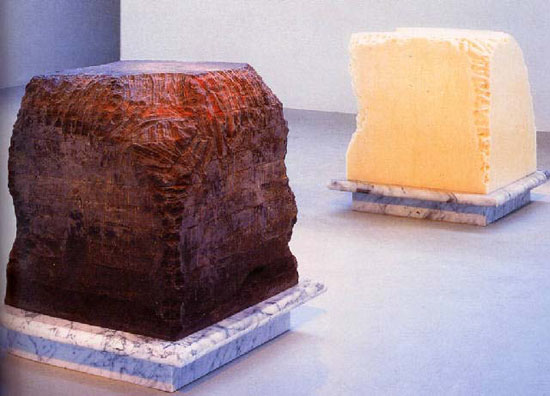
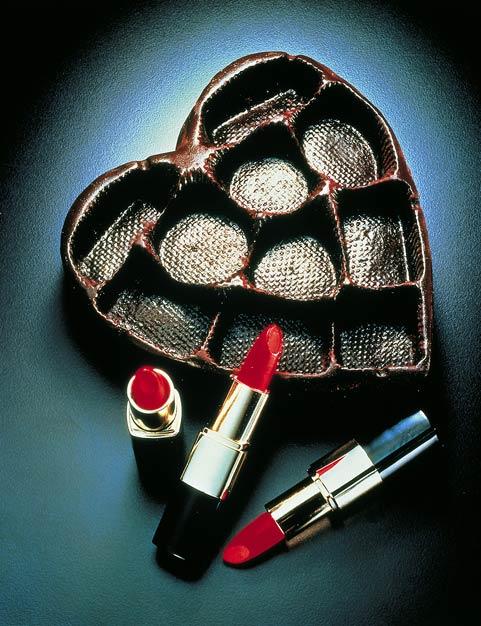
They don't even have to be objects at all; they can be repeated motions, such as the gnawing of a 4'x4'x4' block of chocolate or lard by Janine Antoni in her performance piece entitled simple "Gnaw". It's true that her performance yielded multiple objects of spit out chocolate pieces into a heart shaped box, and spit out pieces of lard which were blended with red colorant and turned into lipstick, as an end result to take away from the piece, but those things never would have existed or mattered in the same way without the "multiple action" that created them.
Apparently, multiples are greatly associated with the ceramics medium. When Justin Novak was questioned about multiples, he seemed to be excited about the idea of making just one of something with the
possibility of making multiples of it. Perhaps making a mold for an object but only using it once. There is the potential there for an endless number of editions to be made, but you can choose to make only one. I like that idea too.